

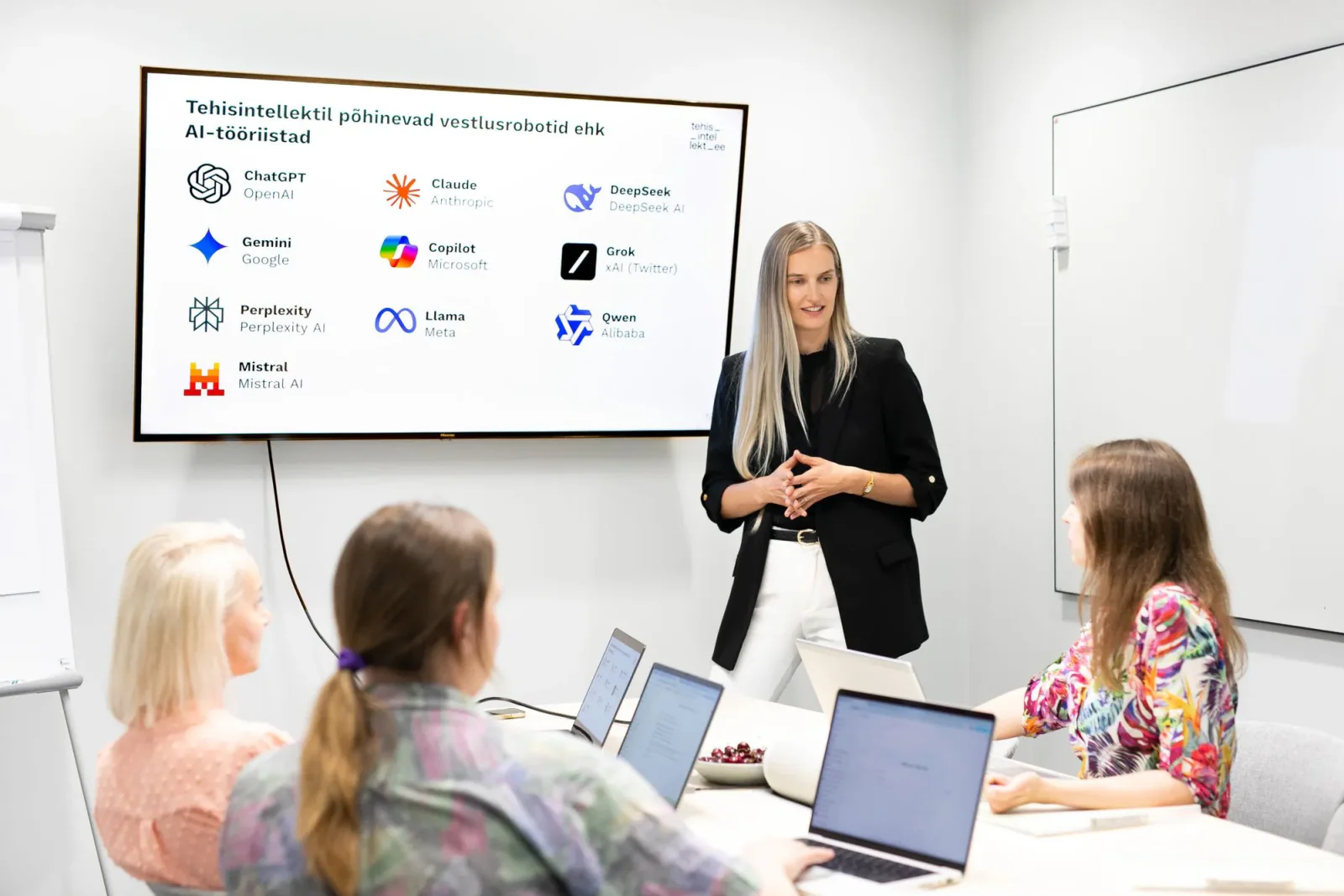
OpenAI ChatGPT introductory training
The OpenAI ChatGPT introductory training is designed for companies that want to give their people a shared understanding of what ChatGPT can do and when to reach for each of its features.
We work through ChatGPT’s main techniques and features in one coherent flow, so that participants leave with a clear sense of what each one is for: choosing a model and a thinking level, files and Library, web search, Deep Research, Memory, instructions, Projects, voice and images, Skills, data analysis, Work, scheduled tasks, and Plugins and Apps.




Course structure
Tap a module to see its contents
- What generative AI is, and how a language model works in principle
- Where AI genuinely helps: finding information, producing content, analysis, and making recurring tasks simpler
- Limitations and risks: hallucinations, outdated information, excessive agreement, and the user’s own responsibility
- What sets ChatGPT apart from other AI tools, and how the ChatGPT environment is laid out
- How to use ChatGPT safely, and what to keep in mind in an organisation’s workspace
- ChatGPT’s main features, and how to choose the right approach for the task at hand
- What makes a prompt clear and effective
- A group exercise: comparing a poor prompt with a good one
- How to give ChatGPT enough context, the goal, the constraints, and the output you want
- When a longer, detailed brief is worth writing, and when a plain question will do
- How to pick the balance of speed and thoroughness that fits the complexity of the task
- When a fast answer is enough, and when more thinking is worth it
- How the depth of thinking affects the speed and quality of the answer, and how much of your allowance it uses
- Uploading and analysing documents, spreadsheets, presentations, images and other files
- Library, for finding and reusing files
- Web search, for finding and verifying up-to-date public information
- Deep Research, for more complex multi-source, multi-step investigation
- When to use an ordinary chat, when web search, and when Deep Research
- Memory and earlier context: what ChatGPT can remember, and how to manage it
- Account-wide instructions and personal preferences
- Project-specific instructions and files
- Projects, for keeping the context of a recurring topic, client or workflow together
- Voice mode, for thinking out loud, talking a question through, and working hands-free
- Analysing images and screenshots, and answering questions from visual information
- Creating and editing images with ChatGPT
Personalised and immediately applicable
The greatest strength of the training was personalisation. Every lesson built on our company's real situations and processes, not textbook examples. The balance of theory and practice and the concrete tips helped us quickly adopt new working methods. The training gave us tools that can be applied immediately, not knowledge that ends up in a drawer.


ENN LAMP
Fiskostar OÜ
CEO
Learning outcomes
What you'll be able to do:
understand the principles, limitations and main risks of generative AI;
know ChatGPT’s main features and which one to use when;
tell apart the situations that call for an ordinary chat, web search, Deep Research or Work mode;
know how to use files, Library, Projects, Memory and instructions to build the context for a piece of work;
try out one clear prompting technique and build a personal Skill for a recurring task;
understand how scheduled tasks, Plugins and Apps extend ChatGPT - automating recurring work and connecting it to other tools and data sources.


KAIA SALUMETS
NG Investeeringud OÜ
Chief Accountant
Encouraging and practical
We gained the courage to experiment and to see how to make our work easier. A start has been made and I am very grateful for it. I especially liked the practical examples. At the same time, I understand that consolidating skills and deepening knowledge requires a lot more practice.
Do you have any questions?
Anna can help with registration, how the training is organised and applying for the Töötukassa training grant.
Training provider contact and details
- Training organiser
- Tehisintellekt OÜ
- Registry code
- 16967299
- Economic activity notice no.
- 259383
- Contact person
- Anna Borovikova
- Phone
- +372 5886 9046
- info@tehisintellekt.ee