Developing a next-generation chatbot for University of Tartu IT support
Kristjan Eljand
Business analyst-trainer
Photo by Andres Tennus, University of Tartu
The University of Tartu is the leading university in the Baltics, with nearly 14,000 students and 3,600 employees. For the university to function successfully every day, smooth access to modern IT services is essential.
Students need fast access to the internet, user accounts, and study information systems. At the same time, staff and lecturers must manage virtual seminars and handle data in complex digital systems. The University of Tartu IT department supports all these needs, managing over 100 information systems and 40 IT services.
A support guide has been created for the university community, consisting of about 500 Estonian and 200 English guides. The information is kept up to date so that everyone can search and find solutions to their IT problems independently.
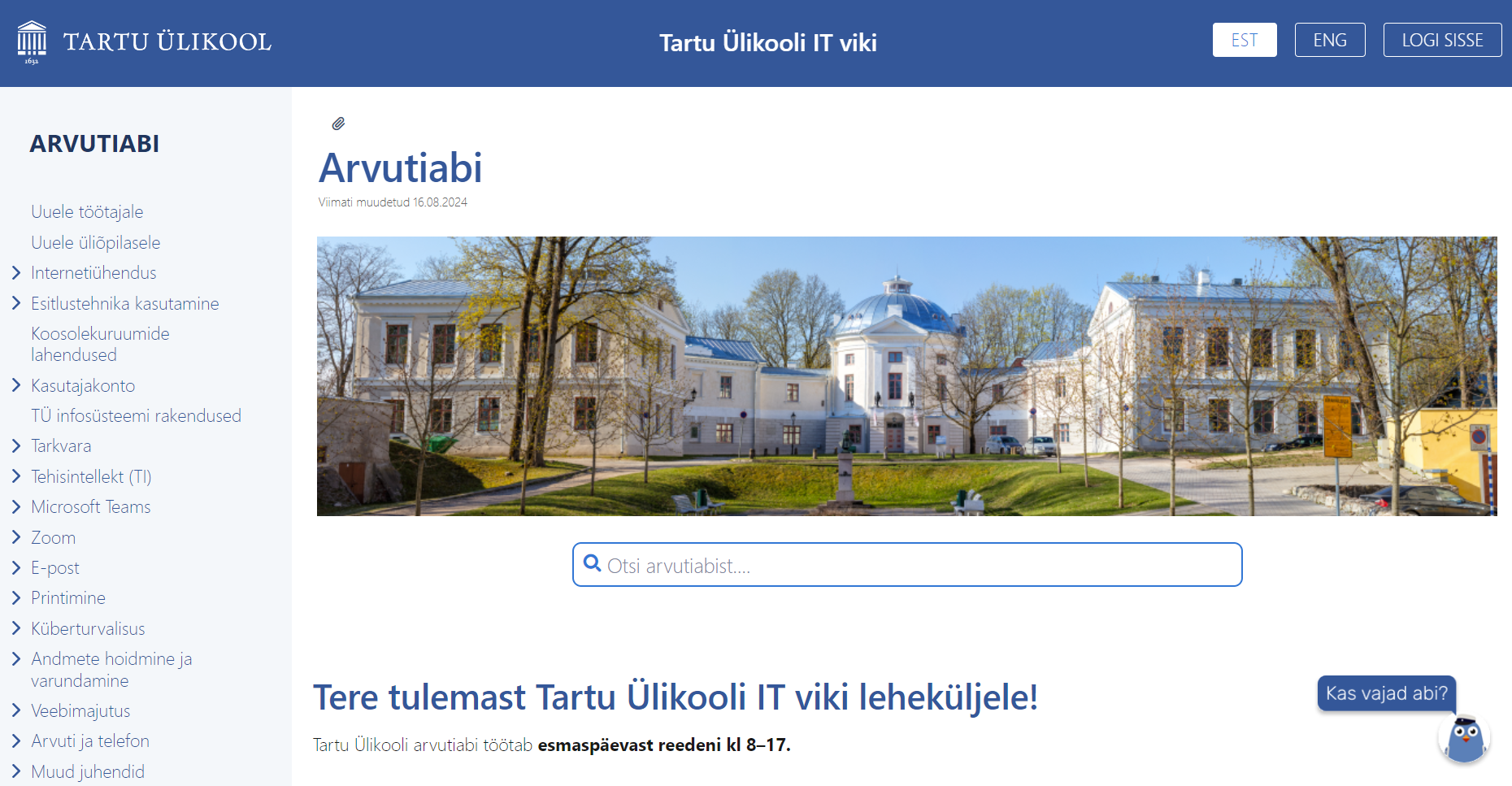
Screenshot of the University of Tartu IT help wiki.
Finding information in guides can be difficult.
Unfortunately, students and staff often contact IT support even though the guides could help them solve the issues themselves. The reason is simple: among hundreds of guides, it’s hard to find the right one for a specific question. This doubles the workload for IT specialists – they write the guides, but still have to answer the same questions manually.
The University’s Head of IT Services reached out to us to see if modern AI could help users find information faster and easier. He emphasized four key requirements:
Any changes in the guides must be automatically updated in the AI’s answers;
Answer quality must be statistically measurable;
The solution must work in both Estonian and English for the multilingual community;
The solution must be secure.
Developing a next-generation chatbot.
We knew that traditional chatbots, which only answer pre-set questions, wouldn’t be enough. We didn’t need simple “yes” or “no” answers; we needed a system that could answer questions based on constantly changing content.
This led us to RAG (Retrieval-Augmented Generation) technology. This means that when a user asks a question, the system first searches the database for the most relevant documents. These guides are then sent to a large language model, like GPT-4, which creates the final answer based on that info. This allows the chatbot to process thousands of documents and provide answers based only on the latest information.
With this technology, the chatbot adapts to new guides instantly. If a new guide for password resets is added to the system, the chatbot can find and use it immediately. This removes the need for manual updates or extra training.
Besides the chatbot, we developed another key feature: thematic analysis of user questions. Every question is stored anonymously, allowing the IT team to track which topics and issues are most common.
Analyzing user questions shows what information people need the most.
This feature helps the IT department make data-driven decisions when creating guides. For example, if many people ask about password changes but there is no clear guide for it, they can address that exact need. Instead of working based on assumptions, IT specialists can act proactively to meet actual user needs.
This is a major shift: creating guides is no longer just a reaction to problems, but a managed process based on real data and user queries.
AI is not perfect, but it is useful.
Is the chatbot perfect? Certainly not – just like humans, AI is never completely flawless. However, we have built a system that learns and evolves over time, growing alongside the university’s needs.
This solution makes life easier for everyone at the university. First, students and staff can work more efficiently because they find answers quickly without searching through documents or waiting for support. Second, the workload for IT specialists is reduced, allowing them to focus on complex issues and improving materials. Third, the answers become more consistent and clear, as the bot uses a single source of truth.
While AI doesn’t replace human judgment, it is a powerful assistant that helps everyone work smarter.